
Balen's India Visit: What’s at Stake for Nepal?
Prime Minister Balendra Shah begins his two-day official visit to New Delhi with high-level talks on energy trade, transit corridors, and sovereign diplomacy. Here is what is on the negotiating table.

 Facebook
 WhatsApp
 X (Twitter)
 LinkedIn
 Telegram
 Reddit
 Threads
 Bluesky
 LINE
 Viber
 Pinterest
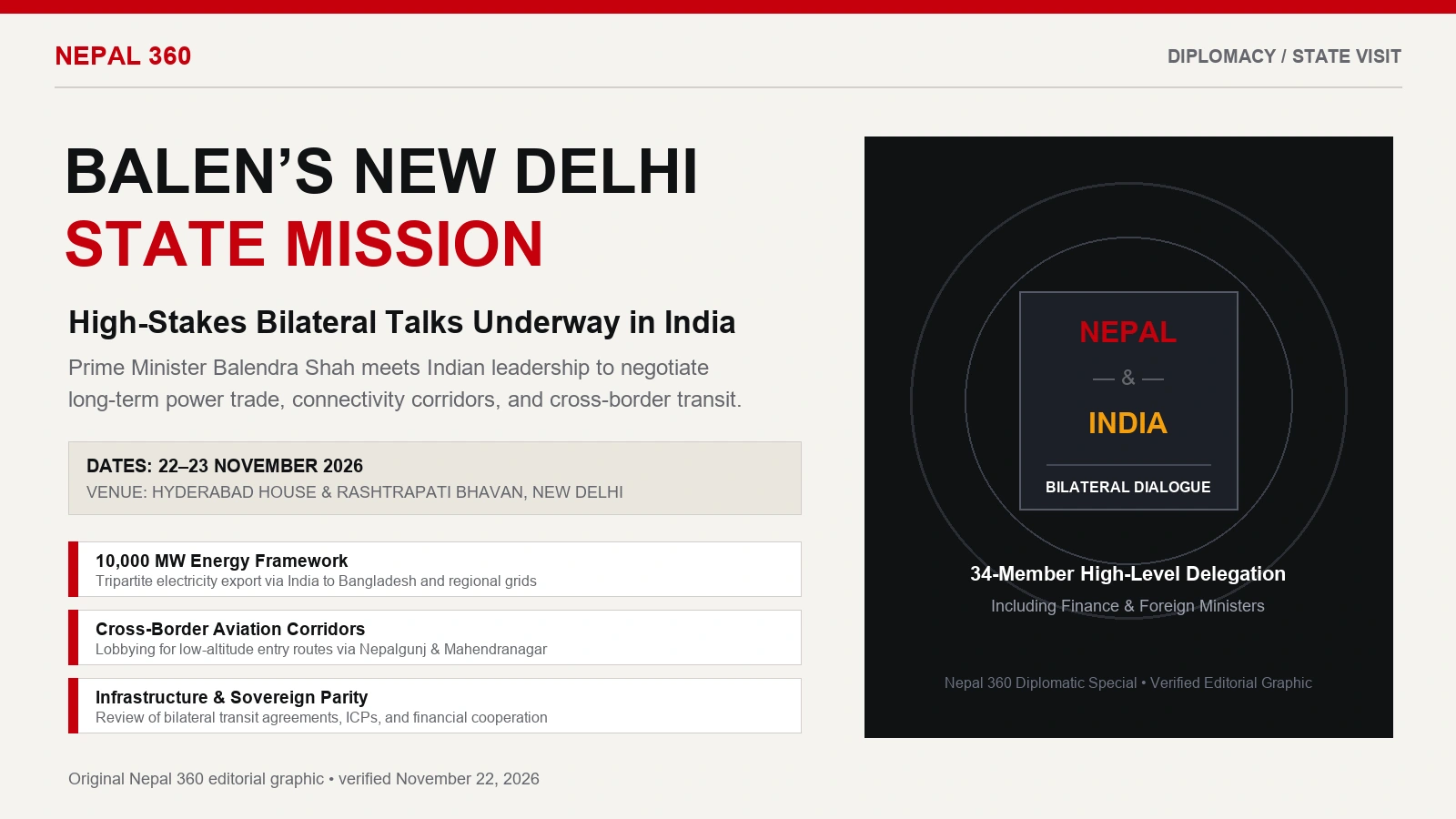
Prime Minister Balendra Shah arrived in New Delhi on Sunday afternoon, November 22, 2026, commencing a pivotal two-day state visit to India aimed at recalibrating bilateral ties, accelerating cross-border infrastructure, and securing long-term economic dividends for Nepal. The trip marks Shah’s first official bilateral visit to India since assuming the prime ministership in March 2026, drawing intense domestic and international attention to how Kathmandu’s new executive leadership navigates its most complex regional relationship.
Upon landing at Indira Gandhi International Airport, Prime Minister Shah and his high-level 34-member government delegation were formally received by India’s Union Minister of State for Electronics and Information Technology, Commerce and Industry, Jitin Prasada. Following standard protocol receptions, Shah held a bilateral discussion on Sunday evening with Indian External Affairs Minister Dr. S. Jaishankar, setting the preliminary groundwork for Monday’s delegation-level summit with Indian Prime Minister Narendra Modi at Hyderabad House.
The visit comes at a defining juncture for Nepal’s macroeconomic and geopolitical landscape. As Kathmandu balances trade deficits, ambitious energy transitions, and urgent calls for sovereign equality in bilateral mechanisms, the discussions in New Delhi carry far-reaching consequences for domestic industries, cross-border commerce, and regional transport architecture.
High-Level Delegation and the New Delhi Agenda
Accompanying Prime Minister Shah is a 34-member official delegation that includes Finance Minister Dr. Swarnim Wagle, Foreign Minister Shisir Khanal, physical infrastructure secretaries, energy planners, and senior representatives from Nepal’s private business chambers. The delegation’s composition reflects a deliberate pivot toward economic diplomacy, commercial viability, and institutional execution rather than merely ceremonial statecraft.
Official schedules confirmed by Nepal’s Ministry of Foreign Affairs (MoFA) and India’s Ministry of External Affairs (MEA) indicate a tightly packed itinerary across November 22 and 23. Key engagements include:
Sunday, Nov 22: Arrival in New Delhi; evening bilateral briefing with External Affairs Minister Dr. S. Jaishankar.
Monday Morning, Nov 23: Tête-à-tête and restricted bilateral negotiations between Prime Minister Balendra Shah and Indian Prime Minister Narendra Modi at Hyderabad House.
Delegation-Level Talks: Comprehensive review of energy trade, cross-border infrastructure, digital commerce, and transit facilitation, followed by a joint media appearance.
Monday Afternoon, Nov 23: Courtesy call on Indian President Droupadi Murmu at Rashtrapati Bhavan, followed by participation in the Nepal–India Business Forum.
Monday Evening, Nov 23: Return flight to Tribhuvan International Airport in Kathmandu.
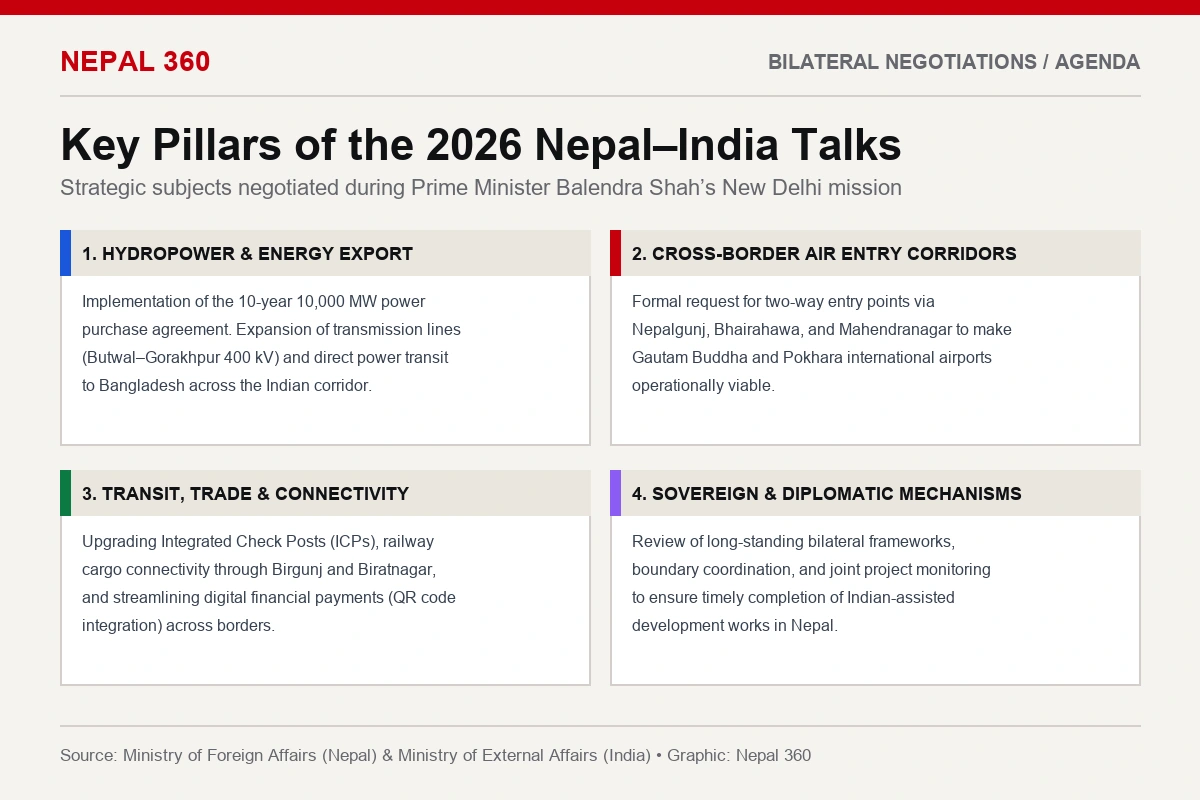
Key pillars of the Kathmandu–New Delhi talks: Long-term energy exports, cross-border transit, and aviation corridors dominate the agenda. Graphic: Nepal 360.
Hydropower Cooperation and Tripartite Power Export
Topping Kathmandu’s strategic economic agenda is the operational execution of the landmark 10-year, 10,000-megawatt power purchase agreement signed previously between the two nations. While policy agreements exist on paper, Nepalese hydropower producers have faced recurring technical hurdles and regulatory delays in securing approvals from India’s Central Electricity Authority (CEA) for specific project clearances and transmission quotas.
During Sunday’s preparatory talks and Monday’s scheduled summit, the Nepalese delegation is pressing for streamlined regulatory clearances for newly commissioned run-of-the-river and peaking storage plants across the Koshi, Gandaki, and Karnali basins. Furthermore, Nepal is seeking expedited transit arrangements across Indian transmission networks to supply electricity to Bangladesh, operationalizing the historic tripartite framework finalized earlier in the year.
Expanding the cross-border transmission grid constitutes a vital technical pillar. Talks are focusing on advancing the Butwal–Gorakhpur 400 kV cross-border transmission line, along with proposed new high-voltage links connecting Inaruwa–Purnea and Lamki–Bareilly. For Nepal, whose wet-season surplus electricity generation routinely exceeds domestic baseload consumption, guaranteed cross-border market access is essential to avoid catastrophic commercial spillage and attract institutional foreign direct investment into storage projects.
Connectivity, Trade Deficits, and Cross-Border Transit
Beyond energy, bilateral trade and transit logistics remain critical issues. Nepal’s merchandise trade deficit with India remains heavily skewed, with petroleum products, industrial machinery, and consumer staples driving substantial import bills. Prime Minister Shah’s delegation is focusing on structural solutions to reduce logistical frictions that increase the cost of Nepalese agricultural and manufacturing exports.
Key items under negotiation include:
Integrated Check Posts (ICPs): Upgrading operational capacity and cargo scanning automation at Birgunj, Biratnagar, and Nepalgunj to eliminate days-long vehicle congestion along border highways.
Railway Transit Expansion: Enhancing direct container cargo movements from Indian ports (Kolkata, Haldia, and Visakhapatnam) to inland dry ports in Nepal, specifically evaluating passenger and freight rail extensions along the Kurtha–Bijalpura–Bardibas corridor and the Raxaul–Kathmandu railway feasibility study.
Digital Financial Interoperability: Formalizing bilateral instant digital payment linkages, allowing interoperable QR-code settlements between Nepal’s retail payment systems and India’s Unified Payments Interface (UPI). The system aims to simplify remittances, slash informal exchange fees for migrant workers, and ease cross-border pilgrimage and tourist expenditure.
The Aviation Question: Western Air Corridors
A contentious and economically urgent subject raised by the Nepalese side is cross-border airspace access. Since commissioning Gautam Buddha International Airport (GBIA) in Bhairahawa and Pokhara International Airport (PIA), Nepal has repeatedly lobbied India to grant low-altitude, bidirectional international air entry routes through western border corridors, specifically via Nepalgunj, Mahendranagar, and Bhairahawa.
Currently, roughly 90 percent of incoming international flights entering Nepal are funneled through the single Simara waypoint in south-central Nepal. For international carriers flying into Bhairahawa or Pokhara from the Gulf, Middle East, or Europe, this restriction forces an inefficient 185 to 300-kilometer detour into eastern airspace before doubling back west—adding up to 23 minutes of flight time and thousands of dollars in extra jet fuel burn per landing.
While New Delhi has cited security and airspace coordination constraints regarding its nearby military facility at Gorakhpur Air Force Station, Prime Minister Shah’s team has placed technical airspace negotiations firmly within the high-level bilateral agenda. CAAN officials stress that without these western entry corridors, Nepal's two provincial international gateways will struggle to maintain financially sustainable, high-frequency commercial airline operations.
Diplomatic Balance and Domestic Political Context
Balendra Shah’s elevation to the prime ministership marked an unprecedented generational shift in Nepali politics, propelled by anti-establishment sentiment and demands for governance reform. Consequently, his state visit is being closely monitored in Kathmandu for signs of how his administration conducts sovereign diplomacy.
Past visits by traditional party leaders were frequently criticized by domestic observers for opaque agreements, unresolved border grievances, and perceived diplomatic subservience. Prime Minister Shah has publicly adopted a posture centered on mutual institutional respect, rigorous economic accountability, and non-partisan national interest.
Diplomatic analysts in both capitals note that New Delhi is equally keen to establish an effective working relationship with Nepal's independent leadership. Indian policymakers recognize that engaging constructive young governance leaders who prioritize infrastructure delivery, clean energy, and administrative efficiency offers stability for cross-border regional development in the eastern sub-Himalayan corridor.
What to Watch as Outcomes Emerge
As delegation-level talks convene on Monday, November 23, the key measures of success will depend on tangible, signed commitments rather than diplomatic pleasantries. Observers will be scrutinizing whether New Delhi agrees to formalize new cross-border electricity purchase quotas, offers clear technical timelines on western air routes, and advances the implementation of bilateral trade infrastructure.
Prime Minister Shah is scheduled to address a joint press briefing with Prime Minister Narendra Modi following Monday’s talks, after which official declarations and project inaugurations will be announced. Nepal 360 will provide real-time updates and expert analysis as confirmed outcomes are released.
How did this story make you feel?
The discussion
0Balen's India Visit: What’s at Stake for Nepal?
Your perspective matters.
Sign in to share your thoughts and reply to other readers.
Reader perspectives
Newest firstStart the conversation
No comments yet. A thoughtful perspective can make this story go further.