
EV Imports Surge Through Korala: What Is Driving the Shift?
Over 7,000 electric vehicles crossed Mustang's Korala border in four months as landslide closures along traditional northern routes turned a remote Himalayan pass into an automotive transit hub.

 Facebook
 WhatsApp
 X (Twitter)
 LinkedIn
 Telegram
 Reddit
 Threads
 Bluesky
 LINE
 Viber
 Pinterest
High in the windswept passes of Upper Mustang, the Korala border crossing between Nepal and China has undergone a dramatic transformation. Long regarded as an isolated trans-Himalayan trading post accessible only during brief seasonal fairs, the border point at 4,600 meters above sea level has rapidly emerged as one of Nepal’s most critical commercial transit arteries, propelled by an unprecedented surge in electric vehicle (EV) imports from China.
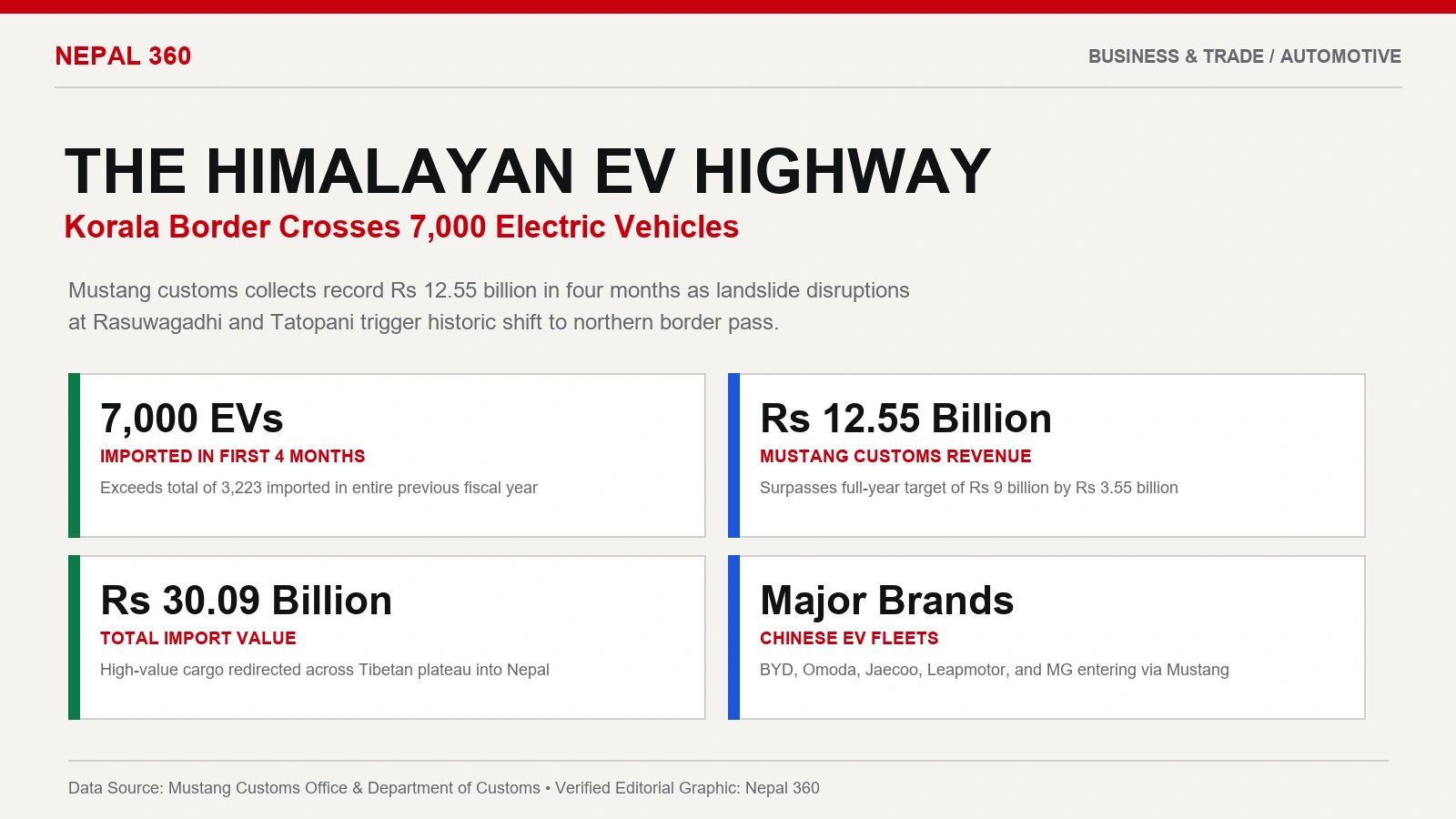
Official trade statistics from the Mustang Customs Office reveal that approximately 7,000 electric vehicles crossed into Nepal through Korala during the first four months of the current fiscal year 2026/27. This figure represents an extraordinary shift in automotive logistics: in just a third of a year, EV import volumes through Mustang have more than doubled the 3,223 total electric vehicles cleared across the border point during the entire preceding fiscal year.
The influx of Chinese-manufactured electric cars, vans, and commercial microbuses has upended traditional trade flows, filled government customs coffers to record levels, and highlighted both the resilience and fragility of Nepal’s northern supply chains.
Floods, Disruptions, and the Sudden Diversion to Korala
The primary driver behind Korala’s sudden commercial boom was not a planned logistical migration, but an emergency response to severe climate and disaster disruptions along Nepal's established northern trade routes. Traditionally, merchandise trade with China has funneled through two primary customs points in central and eastern Bagmati Province: Rasuwagadhi (Kerung) in Rasuwa district and Tatopani (Kodari) in Sindhupalchok.
During the 2026 monsoon season, catastrophic cloudbursts, debris flows, and flash floods across the Bhotekoshi and Trishuli river corridors inflicted devastating structural damage on highway bridges, customs yards, and access roads leading to both Rasuwagadhi and Tatopani. With Kerung facing extended closures and Tatopani suffering severe slope failures, hundreds of millions of dollars in festive goods and automobile consignments were trapped on the Chinese side of the border.
Faced with mounting delivery deadlines for Nepal’s peak festive retail season, major vehicle importers and authorized distributors for Chinese EV manufacturers—including BYD, Omoda, Jaecoo, Leapmotor, and MG—pivoted their supply chains westward. Transporting containerized and driving-ready vehicles across the plateau of the Tibet Autonomous Region to the Korala pass offered an unobstructed overland alternative into Nepal’s Gandaki Province.
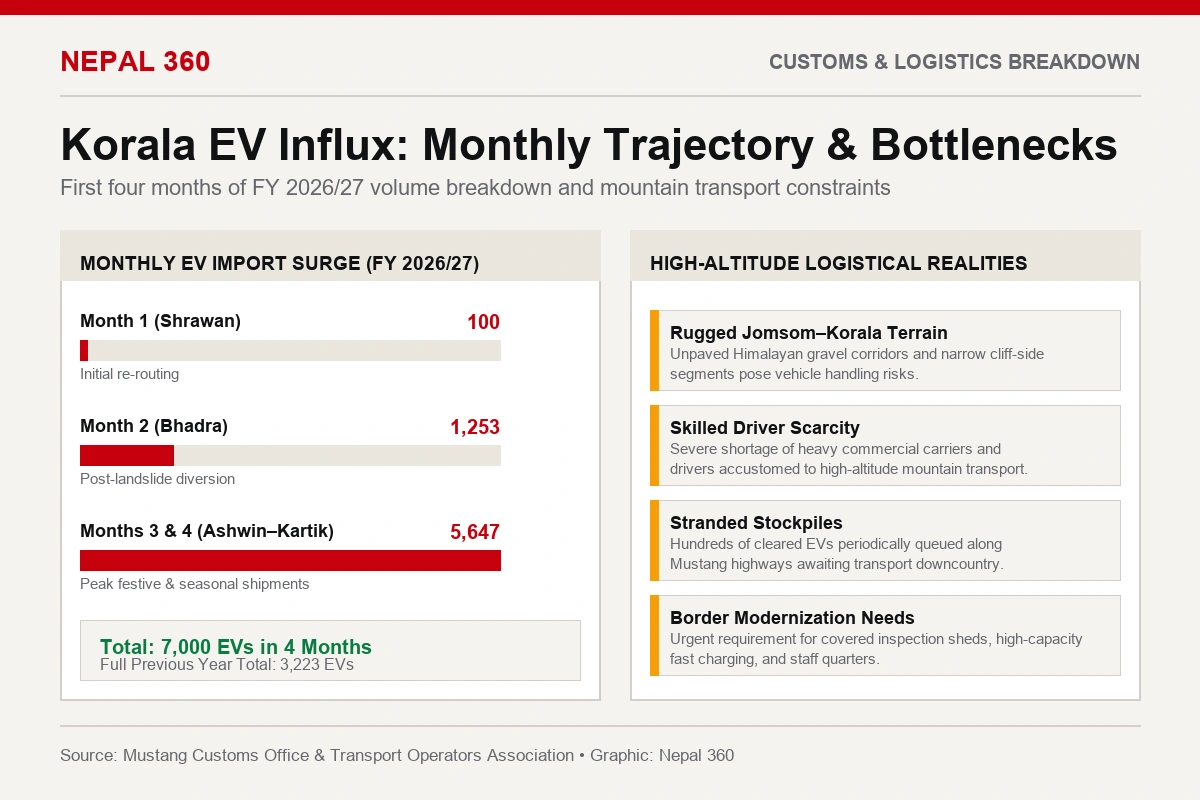
First four months of FY 2026/27: Monthly EV import volumes through Korala surged to 7,000 units, generating record customs revenues. Graphic: Nepal 360.
Mustang Customs Smashes Revenue Targets
The arrival of thousands of high-value electric vehicles, coupled with substantial consignments of electronics, garments, and construction hardware, has produced an unprecedented financial windfall for the local customs administration. According to records maintained by the Department of Customs, the Mustang Customs Office collected Rs 12.55 billion in revenue during the first four months of FY 2026/27.
This achievement is historic on several fronts:
Target Exceeded: The Rs 12.55 billion collection surpasses the office’s annual revenue target of Rs 9 billion by more than Rs 3.55 billion, achieving 139 percent of its full-year objective in just four months.
Total Import Value: Overall merchandise imports from China cleared through Korala crossed Rs 30.09 billion during the period, elevating Mustang into one of the country's top revenue-generating customs points.
Monthly Trajectory: Customs data shows the acceleration of vehicle entries: only 100 EVs crossed in the first month (Shrawan), rising to 1,253 in the second month (Bhadra), before exploding to 5,647 vehicles across the third and fourth months (Ashwin and Kartik).
For Nepal’s Ministry of Finance, which has grappled with sluggish customs revenues from traditional southern land ports, the unexpected surge at Korala provided crucial budgetary support.
The Himalayan Reality: Severe Logistics Bottlenecks
While customs clearance at the border plateau operates with relative speed, moving thousands of sophisticated electric vehicles from the border down to Pokhara and the Kathmandu Valley has exposed glaring infrastructure deficiencies. The journey down from Korala to Jomsom and Beni traverses some of the most challenging terrain in the Himalayas.
Key operational bottlenecks include:
Treacherous Road Conditions: Major sections of the 110-kilometer Jomsom–Korala corridor along the Kaligandaki corridor remain unpaved gravel tracks cut into fragile mountain cliffs. Heavy commercial car carriers cannot navigate the narrow hairpin bends, forcing logistics operators to drive newly imported electric cars individually down the mountain.
Severe Driver Shortages: With thousands of vehicles arriving simultaneously, importers have faced an acute shortage of licensed, experienced mountain drivers willing to navigate steep descents in sub-zero temperatures.
High-Altitude Vehicle Queues: Because individual vehicles must be driven down in convoys, hundreds of cleared EVs have periodically queued along dusty shoulders near Lomanthang and Jomsom for days, awaiting available transport crews.
Lack of Charging Infrastructure: Upper Mustang currently lacks dedicated DC fast-charging networks. Importers have relied on temporary low-voltage wall plugs and diesel generators to top up battery packs before vehicles attempt the rugged mountain journey downcountry.
Implications for Nepal’s EV Revolution and Trade Policy
The Korala import phenomenon underscores the rapid pace of Nepal’s transition toward electric mobility. Electric vehicles now account for over 70 percent of new four-wheeler passenger registrations in Nepal, driven by favorable customs duty structures, high domestic hydropower generation, and escalating consumer demand for zero-emission alternatives.
However, the sudden reliance on Korala serves as a wake-up call for national trade planners. Relying on makeshift alpine roads to handle billions of rupees in sophisticated industrial cargo is inherently unsustainable. For Korala to function as a permanent, year-round northern transit corridor rather than merely an emergency bypass during monsoon disasters, the Government of Nepal must urgently invest in modern infrastructure:
Blacktopping the remaining unpaved sections of the Kaligandaki Corridor.
Constructing permanent, temperature-controlled customs inspection sheds and dry ports at the border.
Deploying industrial-capacity three-phase electrical connections and DC fast-charging stations across Mustang transit towns.
As the winter freeze approaches Upper Mustang and traditional trade corridors gradually undergo repairs, the lessons of the Korala EV surge will shape how Nepal designs resilient, multi-point overland trade networks with its northern neighbor for decades to come.
How did this story make you feel?
The discussion
0EV Imports Surge Through Korala: What Is Driving the Shift?
Your perspective matters.
Sign in to share your thoughts and reply to other readers.
Reader perspectives
Newest firstStart the conversation
No comments yet. A thoughtful perspective can make this story go further.