
Tribhuvan University’s AI Detection Dilemma: Why Court Rejection Won't Settle the Issue
Law students challenged Tribhuvan University's mandatory AI detection rules at the Supreme Court, but an administrative darapith order leaves deep questions about algorithmic accuracy, privacy, and academic evaluation unresolved.

 Facebook
 WhatsApp
 X (Twitter)
 LinkedIn
 Telegram
 Reddit
 Threads
 Bluesky
 LINE
 Viber
 Pinterest
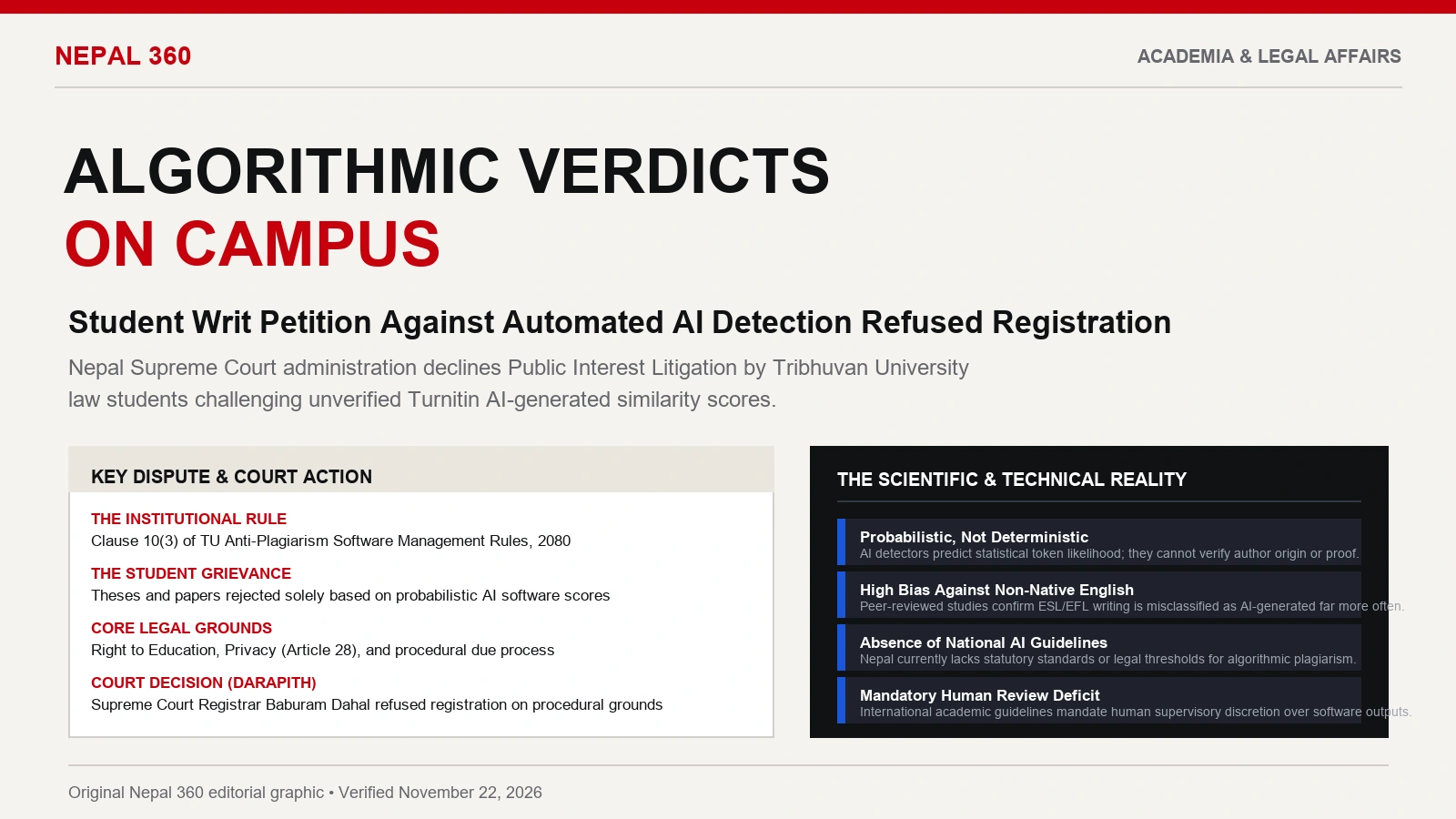
A contentious dispute over academic integrity, algorithmic software, and constitutional rights reached the gates of Nepal’s highest judicial body in November 2026, when law students challenged Tribhuvan University’s (TU) mandatory use of automated artificial intelligence detection software. The controversy—centered on allegations that students are being penalized or having research theses rejected based on unproven probabilistic algorithms—highlights growing friction between educational institutions adopting automated enforcement and students demanding transparent due process.
The legal challenge took a dramatic turn when the Supreme Court of Nepal administration formally refused to register the Public Interest Litigation (PIL) writ petition. Registrar Baburam Dahal issued an administrative rejection order—known in Nepalese jurisprudence as a darapith—concluding that the petition failed to establish a direct violation of fundamental constitutional rights and that university internal academic evaluation rules do not warrant the court's extraordinary jurisdiction.
While the administrative refusal prevents the writ from advancing immediately to a judicial bench hearing, the underlying dispute has ignited an intense national debate across higher education. At stake are fundamental questions regarding algorithmic accuracy, data privacy, and how academic institutions evaluate scholarship in the era of generative AI.
The Roots of the Conflict: TU’s Anti-Plagiarism Rules
The controversy originates from Tribhuvan University’s enforcement of its internal anti-plagiarism guidelines, specifically Clause 10(3) of the Anti-Plagiarism Software Management and Operation Rules, 2080. Under these institutional regulations, graduate dissertations, master’s theses, MPhil research, and faculty seminar papers must pass automated similarity screening through commercial software suites before being accepted for defense or degree conferral.
While plagiarism screening was historically restricted to matching direct text duplication against published academic databases, TU and several affiliated campuses recently integrated third-party AI-detection features developed by commercial providers, notably Turnitin and iThenticate. Under institutional interpretations of Clause 10(3), research submissions that generate AI-similarity indicators above arbitrary institutional thresholds—often set as low as 15 to 20 percent—have been rejected, delayed, or flagged for academic misconduct.
Students from TU-affiliated law campuses—including Nepal Law Campus in Kathmandu and National Law College in Lalitpur—organized collective opposition after numerous students reported having original research rejected despite maintaining rigorous primary citations and research notes.
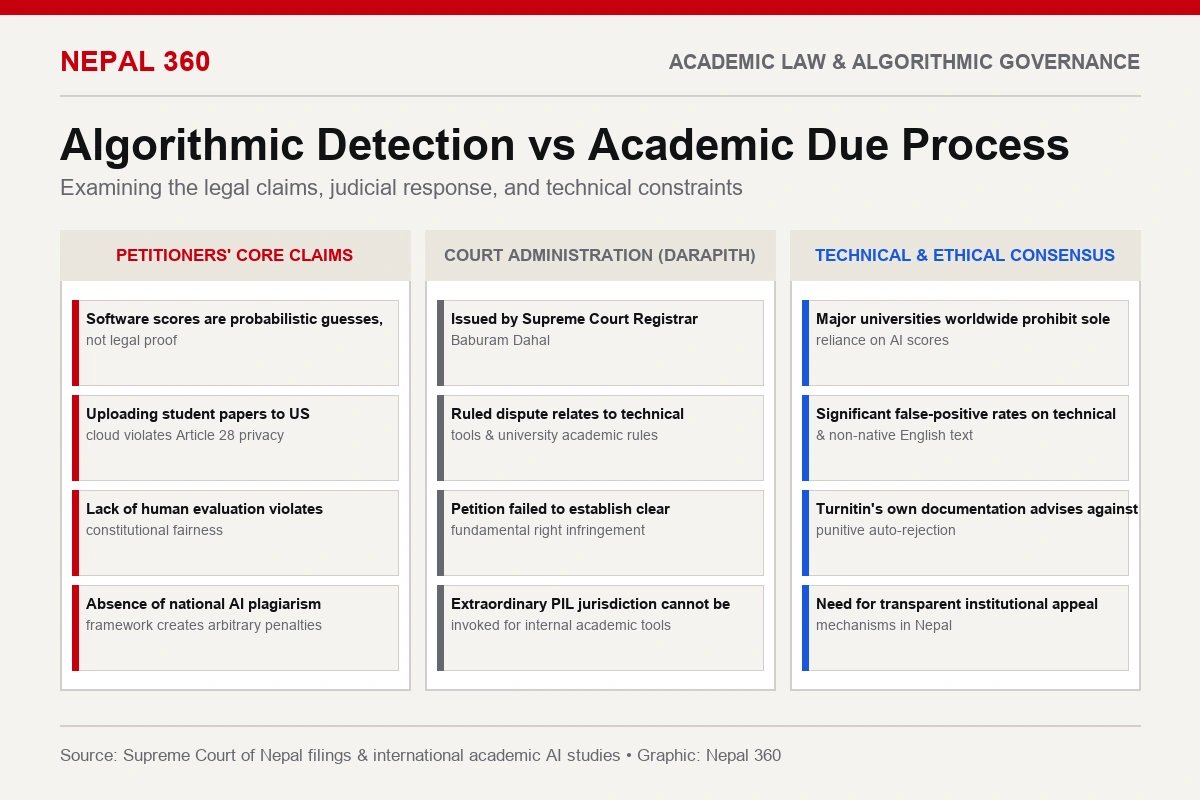
The AI detection dilemma: Student constitutional claims, court darapith rationale, and technical limitations of automated similarity tools. Graphic: Nepal 360.
The Petitioners’ Claims: Algorithms, Privacy, and Due Process
The writ petition was filed by six law students representing the student body: Bivek Chaudhary, Roshan Aauji, Aashish Kesari, Bikesh Kumar Yadav, Pradhuman Kumar Singh, and Nikesh Nepal. In their detailed legal filing, the petitioners raised four core constitutional and technical arguments:
Unverified and Probabilistic Technology: The petition cited independent scientific consensus demonstrating that commercial AI detectors are inherently probabilistic and cannot provide conclusive factual proof of authorship. AI detectors evaluate text based on metrics like "perplexity" (word unpredictability) and "burstiness" (sentence length variation). When students write in formal, repetitive, or academic prose, detectors routinely misclassify human-written sentences as machine-generated.
Absence of National Legal Guidelines: Nepal currently possesses no national legislation, statutory policy, or regulatory framework defining "AI plagiarism" or establishing evidentiary standards for algorithmic outputs in educational institutions. The petitioners argued that penalizing students in the absence of codified national standards violates the constitutional principles of legality and administrative fairness.
Violations of the Right to Privacy (Article 28): Under TU’s current workflow, student research documents, unpublished original data, and intellectual property are uploaded directly into foreign commercial servers based in the United States and elsewhere. The students argued that transferring unpublished domestic research and personal identifying metadata to overseas corporate repositories without explicit statutory authorization violates Article 28 (Right to Privacy) of the Constitution of Nepal and domestic data protection frameworks.
Denial of Natural Justice: The petition alleged that university departments frequently enforce automated rejections without providing students an opportunity for a hearing, manual human review, or an objective appeals mechanism, violating fundamental principles of natural justice.
Based on these grounds, the petitioners sought a writ of mandamus directing Tribhuvan University and the Ministry of Education, Science and Technology to halt automated punitive actions, establish a high-level technical expert committee, and mandate comprehensive human supervisory evaluations.
The Supreme Court’s Darapith Order: Why Registration Was Denied
Rather than proceeding to a preliminary bench hearing before a Supreme Court justice, the petition was halted at the court’s administrative intake. In an order issued by Supreme Court Registrar Baburam Dahal, the administration declined registration under Section 14 of the Supreme Court Rules.
The registrar’s order reasoned that the matter pertained to internal academic evaluation tools, curriculum standards, and technology utilization within autonomous educational institutions. According to the court administration, the petitioners failed to clearly demonstrate which specific, judicially enforceable fundamental constitutional rights had been directly infringed by university policies. Furthermore, the registrar held that disagreements over university evaluation tools could not be appropriately entertained under the Supreme Court's extraordinary public interest litigation (PIL) jurisdiction.
Understanding the Legal Distinction
From a legal reporting perspective, precision is paramount. The registrar’s refusal (*darapith*) is an administrative screening decision, not a judicial ruling on the constitutional merits of AI detection software. The Supreme Court has not issued a ruling declaring AI detectors lawful, nor has it banned their use. Under Nepalese civil procedure, petitioners whose writs are refused registration by court administration retain the legal right to challenge that rejection by filing a formal application before a single bench of the Supreme Court to contest the registrar's order.
What the Science Says: The Global Consensus on AI Detectors
While the court dispute remains suspended on procedural grounds, international academic and computer science literature strongly aligns with the students' technical skepticism. Peer-reviewed evaluations conducted by leading global institutions—including Stanford University, MIT, and the European Union’s Joint Research Centre—have repeatedly demonstrated the fundamental limitations of AI text detectors:
Severe Bias Against Non-Native English Writers: A landmark 2023 study by Stanford researchers revealed that commercial AI detectors falsely misclassified essays written by non-native English speakers as AI-generated more than 61 percent of the time. Because ESL (English as a Second Language) writers typically employ more structured, conventional grammar and vocabulary, algorithms routinely mistake linguistic uniformity for automated text generation. For Nepali students writing theses in English, this algorithmic bias poses a severe risk of unjust false accusation.
Vendor Disclaimers: Even developers of detection tools acknowledge these constraints. Turnitin’s official guidance notes that its AI writing indicator is intended solely as an investigative flag to facilitate dialogue between professors and students, explicitly advising institutions against using similarity scores as sole, punitive proof of academic dishonesty. Several major global universities, including Vanderbilt and the University of Pittsburgh, have disabled automated AI detection features entirely due to unacceptably high false-positive rates.
The Path Forward for Higher Education in Nepal
The controversy at Tribhuvan University reflects a broader institutional challenge facing educational authorities across South Asia: trying to police rapidly evolving generative technologies with rigid, automated software filters rather than modern pedagogical reform.
Regardless of whether the student petitioners pursue a judicial challenge against the registrar’s *darapith* order, academic leaders emphasize that universities cannot outsource academic integrity to proprietary algorithms. The constructive path forward requires Tribhuvan University to establish transparent national guidelines, update assessment methodologies toward oral defenses and research process tracking, and ensure that human judgment always supersedes automated software scores.
How did this story make you feel?
The discussion
0Tribhuvan University’s AI Detection Dilemma: Why Court Rejection Won't Settle the Issue
Your perspective matters.
Sign in to share your thoughts and reply to other readers.
Reader perspectives
Newest firstStart the conversation
No comments yet. A thoughtful perspective can make this story go further.