
NPL 2026 Review: Sudurpaschim’s First Title, Results and Standout Players
Sudurpaschim Royals won their first NPL title as George Munsey’s unbeaten 125 settled the final. Review the completed season’s results, league table, leading players and awards.

 Facebook
 WhatsApp
 X (Twitter)
 LinkedIn
 Telegram
 Reddit
 Threads
 Bluesky
 LINE
 Viber
 Pinterest
Sudurpaschim Royals ended two seasons of final-day disappointment with a title-winning performance that left no room for another heartbreak. George Munsey’s unbeaten 125 carried them to a 10-wicket victory over defending champions Lumbini Lions in the Nepal Premier League final at Kirtipur on November 21, 2026.
The result gave the Royals their first NPL championship at the third attempt. It also supplied the defining image of a season in which established internationals, emerging Nepali players and a demanding playoff race shared the stage. The final was emphatic; the route to it was considerably less comfortable.
This season review uses completed results and statistics checked through November 22, 2026. The tournament has concluded; the points table below records the league stage, not the final championship order.
NPL 2026 at a glance
The third edition of the Cricket Association of Nepal’s franchise T20 competition ran from October 26 to November 21 at the Tribhuvan University International Cricket Ground in Kirtipur. Eight teams contested a single round-robin league, followed by four playoff fixtures: Qualifier 1, the Eliminator, Qualifier 2 and the final.
The completed fixture record contains 32 scheduled matches. Lumbini’s league meeting with Chitwan Rhinos was abandoned without a ball being bowled, leaving 31 decided games. The league phase ended on November 15, with the playoffs beginning two days later.
The final: Munsey turns a chase into a procession
Lumbini made 155 for six after being asked to bat. Dilip Nath’s unbeaten 39 from 31 balls was their highest individual contribution, with Rohit Paudel adding 30, Niroshan Dickwella 28 and Ali Sheikh a brisk 24. Scott Kuggeleijn took two for 25 for Sudurpaschim.
The target of 156 disappeared in 13.3 overs. Munsey hit eight fours and 12 sixes in his 54-ball innings; Binod Bhandari remained unbeaten on 30 from 27. Their unbroken opening stand brought Sudurpaschim to 158 without loss, with 39 deliveries unused. Munsey was named Player of the Match.
Those figures, verified against the final scorecard, explain the margin more clearly than any description of dominance. Lumbini did not take a wicket; Munsey alone scored more than four-fifths of the target. For a side that had already lost to Lumbini twice during this tournament, the reversal was decisive.
Sudurpaschim had finished runners-up to Janakpur Bolts in 2024 and Lumbini in 2025. This time, they completed the job with both openers still at the crease.
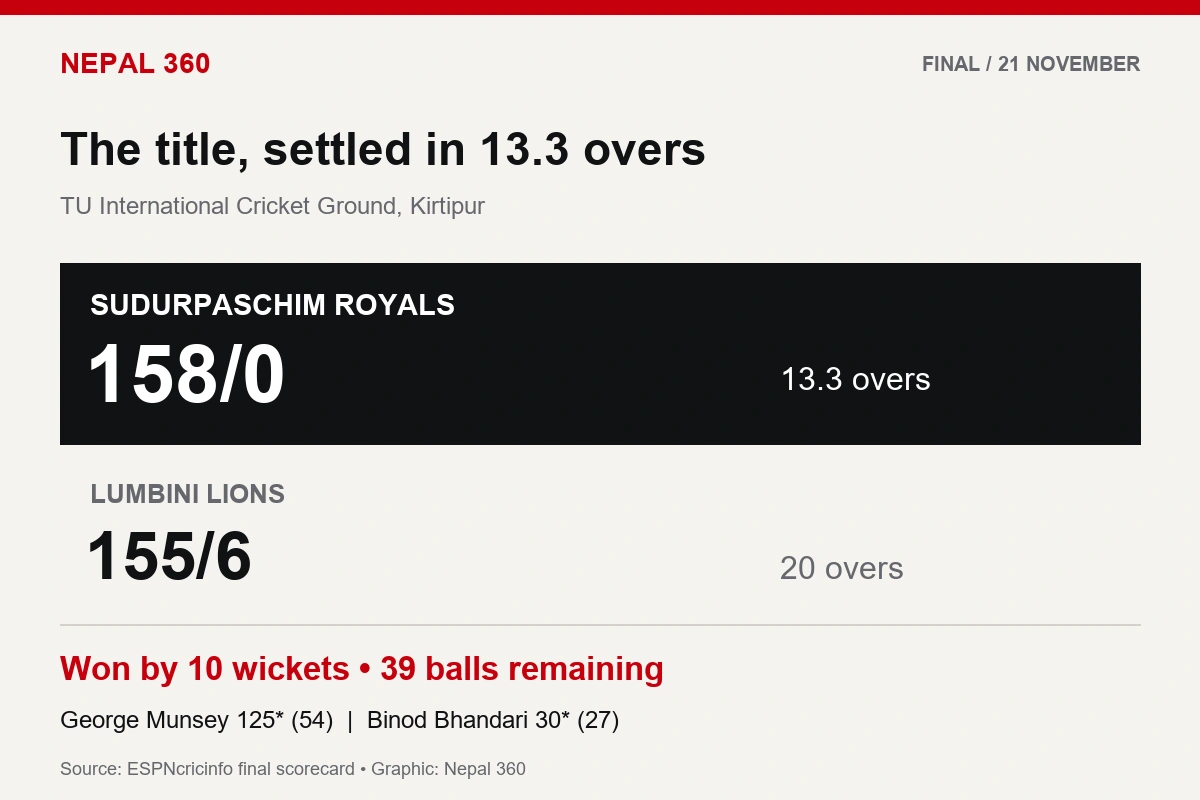
Sudurpaschim completed the final chase with 39 balls remaining. Original graphic: Nepal 360; data: ESPNcricinfo.
Final league standings: Lumbini led, Sudurpaschim prevailed
Lumbini topped the league with 11 points, one ahead of Sudurpaschim. Kathmandu Gorkhas and Chitwan secured the other playoff places. The distinction matters: finishing first earned Lumbini an advantageous route through the playoffs, but the championship was decided separately in the final.
Each team played seven league fixtures. Wins earned two points and no-results one. Net run rate separated the two teams on six points and the two on four. The following figures match ESPNcricinfo’s final league table.
Team | W | L | NR | Pts | NRR |
|---|---|---|---|---|---|
Lumbini Lions | 5 | 1 | 1 | 11 | +1.256 |
Sudurpaschim Royals | 5 | 2 | 0 | 10 | +0.135 |
Kathmandu Gorkhas | 4 | 3 | 0 | 8 | +0.360 |
Chitwan Rhinos | 3 | 3 | 1 | 7 | +0.011 |
Biratnagar Kings | 3 | 4 | 0 | 6 | −0.467 |
Karnali Yaks | 3 | 4 | 0 | 6 | −0.640 |
Pokhara Avengers | 2 | 5 | 0 | 4 | −0.175 |
Janakpur Bolts | 2 | 5 | 0 | 4 | −0.422 |
W: wins; L: losses; NR: no result; Pts: points; NRR: net run rate. These are league-stage figures only.
Eight teams, contrasting campaigns
Lumbini, captained by Rohit Paudel, had the strongest league record, while Dipendra Singh Airee’s Sudurpaschim combined five league wins with a successful recovery from a playoff defeat. Kathmandu, led by Karan KC, reached eight points but could not turn qualification into a sustained knockout run.
Chitwan’s progress was built around contributions from different parts of the squad: Rijan Dhakal led the wicket-taking charts, Ravi Bopara finished among the leading run-scorers, and Kamil Mishara delivered their outstanding knockout innings. Their fourth-place league finish ultimately became a third-place tournament finish.
Biratnagar and Karnali both won three league games and missed qualification. Biratnagar nevertheless produced the leading Nepali run-scorer in Lokesh Bam. Pokhara finished seventh despite having the tournament’s leading run-scorer, Yuvraaj Samra. Janakpur’s two wins left them eighth, but Rahul Yadav’s breakthrough gave the inaugural champions a significant individual success.
How the playoffs unfolded
The playoff format gave the leading two teams a second opportunity after defeat. Sudurpaschim used that protection: beaten in Qualifier 1, they returned through Qualifier 2 before winning the trophy. Kathmandu’s third-place league finish offered no such safety net.
Date | Stage | Result |
|---|---|---|
Nov 17 | Qualifier 1 | Lumbini 108/4 beat Sudurpaschim 105/8 by six wickets. |
Nov 18 | Eliminator | Chitwan 204/4 beat Kathmandu 143/9 by 61 runs. |
Nov 19 | Qualifier 2 | Sudurpaschim 136/7 beat Chitwan 133/9 by three wickets. |
Nov 21 | Final | Sudurpaschim 158/0 beat Lumbini 155/6 by 10 wickets. |
Qualifier 2 was the narrow escape that made the final possible. Sudurpaschim reached their target with only one ball remaining, a very different finish from the comfortable chase two days later. Chitwan’s campaign ended just short of the title match despite a substantial Eliminator victory.
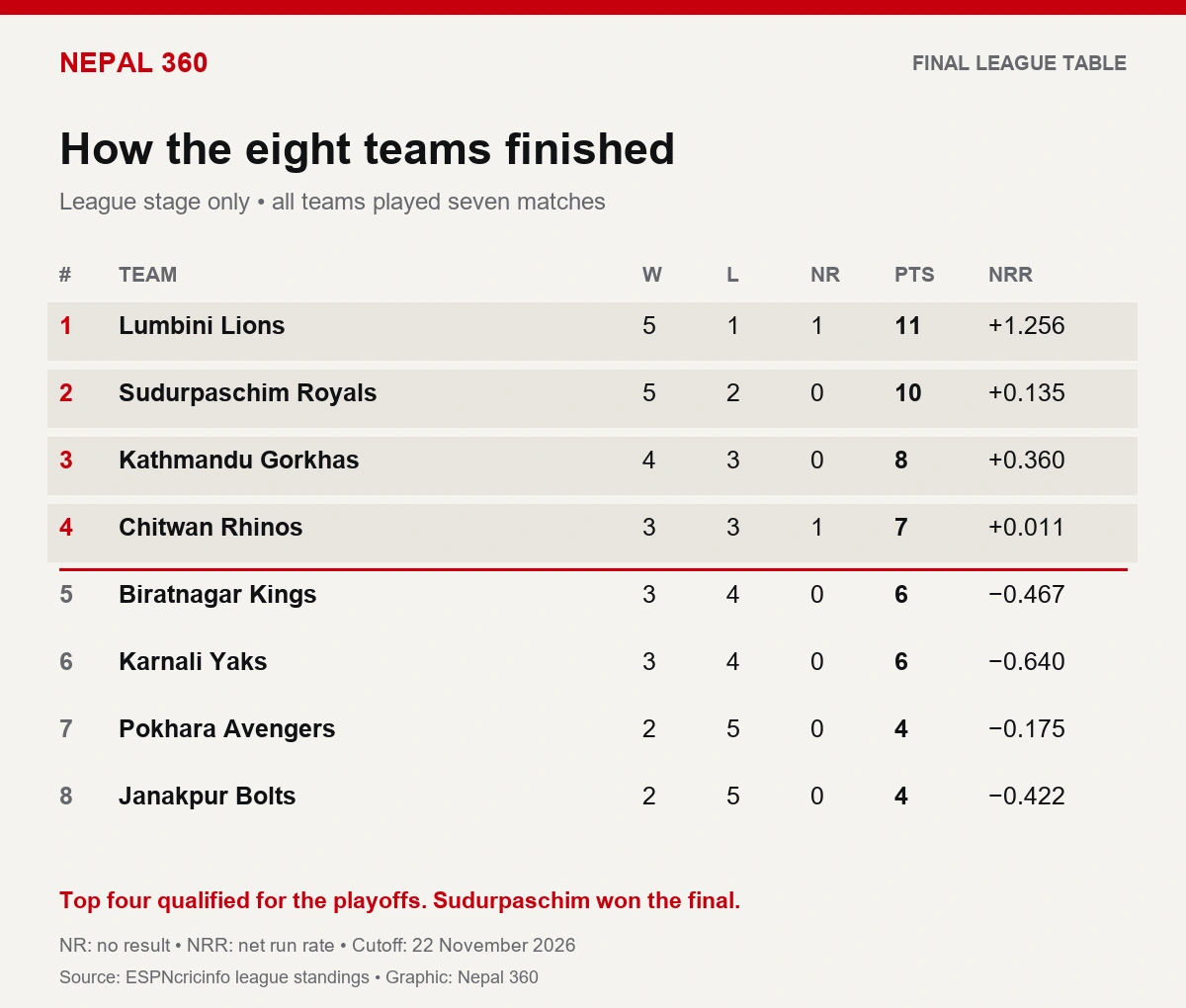
The top four advanced to the playoffs. League position and championship finishing position are different measures. Original graphic: Nepal 360; data: ESPNcricinfo.
Leading performers: Samra’s runs, Dhakal’s wickets
Samra finished with 294 runs from four innings for Pokhara, an average of 73.50. Bam followed with 242 for Biratnagar, the highest aggregate by a Nepali batter. Bopara’s 238 for Chitwan placed him third, followed by Kushal Bhurtel on 235 and Dawid Malan on 220.
Dhakal took 17 wickets in eight bowling innings at an average of 9.88. Kuggeleijn finished second with 15, and Chitwan’s Kamal Singh Airee took 13. Rahul Yadav and Kathmandu’s Jahandad Khan each finished with 12. These totals are from the completed-season batting and bowling records, including the final.
Dipendra’s value extended across disciplines: 217 runs and seven wickets accompanied his captaincy of the champions. That combination helps explain why the Player of the Tournament award did not simply follow the largest batting or bowling total.
The emerging player who made an immediate impression
Rahul’s season offers a different measure of the competition’s value. Selected through Janakpur’s talent hunt, the teenage fast bowler earned opportunities immediately and took four wickets against Kathmandu on October 29. The Kathmandu Post’s reporting described how quickly supporters responded to his performances.
His 12-wicket season ended with the Emerging Player award. For Nepal, the useful next step is sustained development beyond those first appearances: coaching, competitive overs and the chance to establish consistency after an encouraging introduction.
The innings and spells that stood out
Munsey’s 125 not out in the final became the highest individual score in NPL history, overtaking Mishara’s unbeaten 120 only three days earlier. Mishara’s Eliminator innings came from 59 balls and included 10 sixes, helping Chitwan reach 204 for four. Bopara added 53 in that match.
Samra supplied the season’s earlier century, scoring 102 from 48 balls against Karnali on November 9. Pokhara made 217 for three and won by 63 runs. His performance demonstrated how an individual could reshape a team’s batting output even during a campaign that ended outside the playoff positions.
On the bowling side, Sandeep Lamichhane’s six for 27 against Pokhara was the season’s standout return. Dhakal’s best figures were four for 16, while Mark Watt returned four for 12 for Karnali against Lumbini. Such performances underline why the final table should be read alongside individual records: noteworthy cricket came from teams throughout the standings.
Awards: recognising different kinds of contribution
Post-final awards reporting confirmed Dipendra Singh Airee as Player of the Tournament and Dhakal as the best Nepali player. Dhakal also took the Golden Cap for most wickets; Samra received the Platinum Cap for most runs.
Bam was recognised as the highest-scoring Nepali batter, Rahul as Emerging Player, and Mishara as Energetic Player. Munsey’s final-match award completed a list that distinguished tournament aggregates, domestic achievement, emerging talent and performance in the title decider.
What the season means for Nepali cricket
The NPL’s strongest argument remains the opportunity to put domestic players in consequential matches alongside experienced internationals. This season offered several versions of that exchange: Bhandari sharing a championship-winning stand with Munsey, Dhakal leading the bowling table, and Rahul establishing himself in a franchise side.
Chitwan also illustrated the growing investment in preparation. Before the tournament, OnlineKhabar reported that the franchise had appointed Sohail Tanvir as head coach and held a month-long camp for its Nepali players. Work of that kind matters beyond a single overseas signing because it expands the support available to domestic cricketers.
The commercial platform widened too. NetTV secured worldwide OTT rights, Himalaya Television acquired domestic television rights, and eSewa handled ticketing, according to reporting on CAN’s rights awards. Those arrangements describe distribution and commercial commitments; they should not be confused with independently audited audience or revenue totals.
There were practical pressures alongside the spectacle. The Kathmandu Post’s season assessment highlighted concerns over pitch durability at a single venue and the handling of final-ticket demand. Those are relevant tests of whether growing interest can be supported by dependable facilities and event management.
Nepal 360 has previously covered Nepal cricket’s digital storytelling. The NPL adds another setting in which that enthusiasm can become sustained engagement. Its longer-term value will depend on how effectively attention and investment translate into playing opportunities, player development and a better spectator experience.
What comes next
For now, the sporting conclusion is clear: Sudurpaschim are champions, Lumbini runners-up, and Munsey’s unbeaten century is the innings that settled NPL 2026. For the other franchises, the completed scorecards provide a more useful starting point for review than reputation alone. The next challenge is to carry the season’s strongest performances and lessons into the work between tournaments.
Reporting note: results, final standings and player aggregates were checked against ESPNcricinfo; match context, awards and wider developments were cross-checked with the linked reporting. Conflicting team-prize figures have been omitted. All three visuals are original Nepal 360 graphics, not photographs of match events.
How did this story make you feel?
The discussion
0NPL 2026 Review: Sudurpaschim’s First Title, Results and Standout Players
Your perspective matters.
Sign in to share your thoughts and reply to other readers.
Reader perspectives
Newest firstStart the conversation
No comments yet. A thoughtful perspective can make this story go further.